
How to Care for Quilts
The National Quilt Museum’s Collection comprises nearly 700 quilts. In this video, Laura Hendrickson, Director of Collections and Registrar, illustrates how quilts are cared for at the museum. For more tips on quilt conservation, see the article below by Gerald E. Roy of the Pilgrim Roy Collection.
Quilt Care Tips by Gerald E. Roy of Pilgrim Roy Collection
Quilts like the same environments that we do. They prefer an atmosphere that isn’t too hot, too cool, too wet, or too dry.
Flat and folded storage:
They most often prefer to be stored flat so a few quilts on a guest room bed with an old bed sheet that has been washed many times on top, as a cover from strong light and dust is my first choice. There have always been chests built for storing bedding, some are cedar for moth protection, but unless the quilt is wool there is no need for concern. However, there is a need to fold the quilt and that presents another problem.
Fold lines are difficult to remove so using acid free tissue, crunched up along the fold lines is a very good way of avoiding this problem. This method can be used whenever multiple quilts are to be stored anywhere such as closets shelves, etc. and always protected from strong light. Keep quilts out of strong sun light especially.
Storing quilts in old pillow cases is also good as the pillow cases can be washed often. If the quilt is stored directly on a wooden surface then cloth should always be used on that surface to protect from any acid burn, a brown stain that that can happen if the wood is still new.
Clear coating materials are available today that can be applied to the wooden surface that can effectively provide the same protection.
Acid free boxes are also available and these are excellent for quilt storage. Acid free tissue should be used along with these as folding is necessary. Acid free tissue needs to be replaced at least once a year and refolding quilts should happen every six months just as a method of examination alone to check for any condition changes.
Rolling as Storage:
Most Textile Conservators will suggest rolling as a way of storing textiles including quilts.
The best tubes for rolling are those that are acid free and of a large enough diameter to work effectively. Some PVC building materials work well for this.
The most important factor is to cover the roll with acid free material and when rolling make sure the front of the textile is facing out. This causes less distortion to the front than the reverse. Horizontal storage is better than vertical storage in this case.
Cleaning recommendations:
There are fabrics in old quilts, especially, that will deteriorate when subjected to water.
There are stains in old quilts that will not come out except if the stain is subjected to treatments that are going to do more harm than good.
When a quilt is full of water, unless handled properly, there is damage that can occur to quilting as well as seams.
Dry Cleaning – simply DO Not.
A safe process for dust removal is using the lowest setting of the AIR DRY selection on your clothes dryer.
My best advice when asked about washing, especially of it is an important family quilt, historical quilt, early quilt, Is to ask a reputable Textile Conservator. When a quilt has begun to deteriorate, should you have it restored or repaired?
Technically “restoration” is returning it to the exact same as when it when it was newly made, same fabrics, same quality workmanship, etc.
I will often suggest recreating the quilt using fabric facsimiles of the originals rather than trying to fix it. Fabrics that have seen better days will not even support new stitching so a new quilt based on the old one is a far better way of respecting the original maker.
Gerald E, Roy
Pilgrim Roy Collection

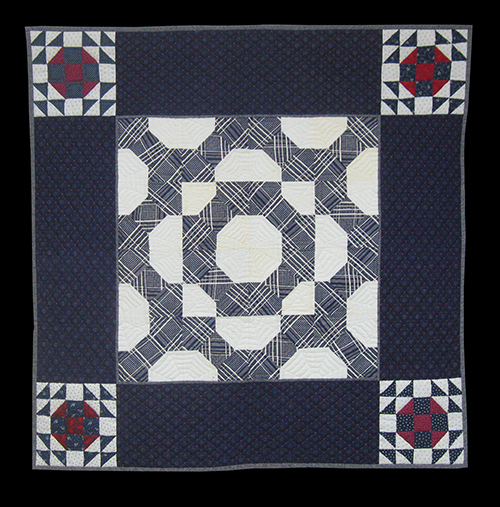
“Complementary Composition”
About Gerald Roy
The names Pilgrim and Roy are internationally recognized in the quilting world. Paul Pilgrim and Gerald E. Roy started working with antique quilts in the early 1960s when their interior decorating business prompted them to purchase antique quilts for clients. Paul and Gerald were among the first board members of the Quilt Appraisal Program of the American Quilter’s Society. Gerald is currently the administrator of the program. Along with Paul, he helped establish guidelines for the certification program, the only one of its kind for quilted textiles. The duo also designed the interior of The National Quilt Museum. Gerald Roy is an art teacher, painter, quiltmaker, and author. He is an advisor and consultant to the textile and fashion department of the Museum of Fine Arts, Boston, The National Quilt Museum, and assists other museums in developing their quilt collections.
Source: www.americanquilter.com
“Bow Tie Crib Quilt”